
Honor’s Two Competing Maxims
Sonne und BetonThis thread traces how the inherited advice to avoid trouble collides with a street code that treats retreat as weakness, leaving Lukas to question whether either maxim can keep him safe.
increasing Bearing strength in each event
 decreasing
Bearing strength in each eventdecreasingThe Father’s Rule
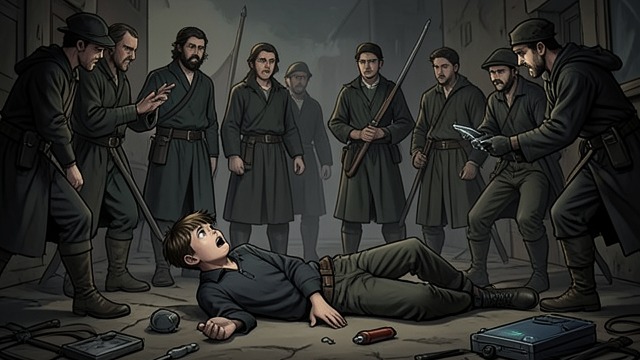
The Cost of Giving Way
Silence after the assault
Gino and Julius stand frozen while Djamel and his friends hit Lukas. Once the attackers leave, Lukas angrily accuses his friends of doing nothing, but then recognizes that he might also have frozen in the same situation. His anger gives way to the thought that intervention could have brought a much larger attack.
He weighs the immediate beating against the possibility of retaliation at school or across the neighborhood. In his reasoning, refusing to fight is not cowardice so much as an attempt to prevent violence from multiplying.
The rule’s uneasy appeal
Lukas’s own experience therefore does not simply disprove his father’s advice. It reveals its cruel limitation: retreat may avoid one danger while leaving the person exposed to another. The maxim offers no reliable answer to a teenager who cannot control whether others choose violence.
The Counter-Maxim
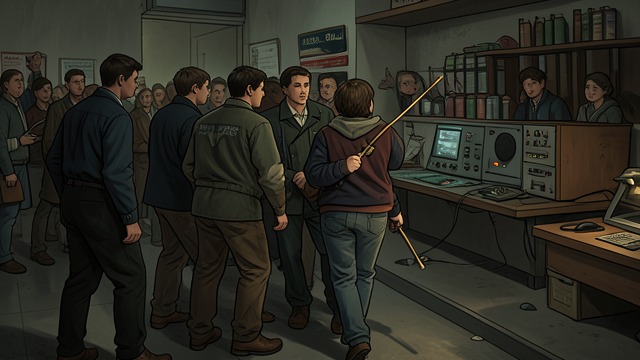
The Counter-Maxim
From victim to recruited fighter
After hearing that Lukas was attacked, Cem insists that the group return to confront Djamel. He gives Lukas a telescopic baton and tells him to strike first, promising that his own people will handle any resistance. Julius encourages the plan, while Gino admits that he wants to leave.
Cem’s proposal turns violence into a test of character. Lukas is told that allowing the assault to stand would mean accepting humiliation, while the weapon offers a way to reclaim control.
The body refuses the script
As the group approaches Djamel’s crowd, Lukas imagines himself attacking, but his legs stop and the baton slips from his hand. Cem takes over and starts the fight himself. Lukas escapes rather than joining in, a choice that frustrates the gang’s simple distinction between courage and weakness.
His paralysis does not erase his fear or make the situation safe. It does, however, prevent him from becoming the person Cem’s retaliatory plan requires him to be.
The Brother’s Revised Lesson
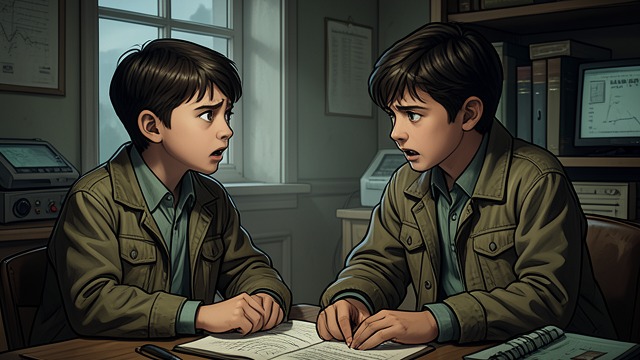
The Brother’s Revised Lesson
Flight as survival
Marco hears that Lukas was involved in a fight and privately warns him not to get mixed up with dangerous people. He recalls his own past street life and tells Lukas that if someone has a knife, he should run; if escape is impossible, he should hand over his phone rather than risk his life.
The advice differs from the father’s gentler call to avoid trouble because Marco speaks from experience with the escalation that can follow a confrontation. His account makes survival more important than winning or preserving status.
The contradiction remains
Yet Marco also tells Lukas that if an opponent is weak, he should hit back. His guidance preserves the logic of retaliation even as he warns against it, leaving Lukas with no stable rule for deciding when to flee and when to fight.
Lukas admires his brother’s confidence and fears the history behind it. He can imagine the power that comes with being known and feared, but also recognizes the cost: repeated injuries, trouble with the police, and people who keep demanding something from you.
A Neighborhood Code
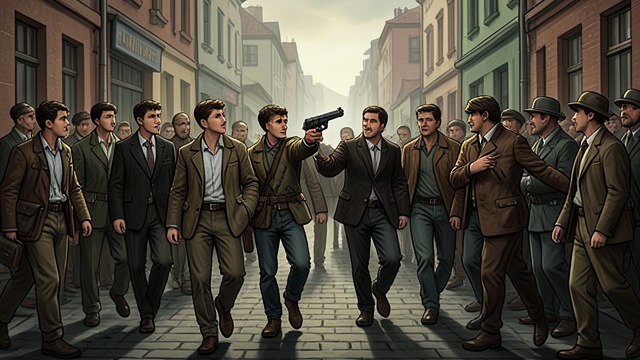
A Neighborhood Code
Reputation as protection
When the friends transport the stolen computers, Julius speaks and behaves as if fear should be answered with defiance. He rejects caution, carries a blank-firing gun, and later fires it at men who challenge the group in the street.
The gunfire disperses the bystanders but also turns a risky theft into a public, violent confrontation. Julius treats intimidation as proof that the group cannot be pushed around, while Lukas experiences each escalation as another chance to be caught or hurt.
The trap in proving oneself
Their different reactions expose the limits of the local honor code. The friends need cooperation to move the computers, but they cannot agree on how much risk is acceptable or whether a display of force is worth its consequences.
Julius’s threat may provide a momentary escape, yet it does not produce security. It makes the group’s actions more conspicuous and binds their fate more tightly to the possibility of retaliation and police attention.
The Rule Remains Unsettled
The Rule Remains Unsettled
Violence enters the home
After learning that Gino has struck his father with a bottle and run away, Lukas discovers that Julius encouraged him to do it and supplied Tilidin. Julius says he wanted to help Gino escape a home where violence had left him feeling powerless, but his intervention has turned fear and desperation into a potentially life-threatening attack.
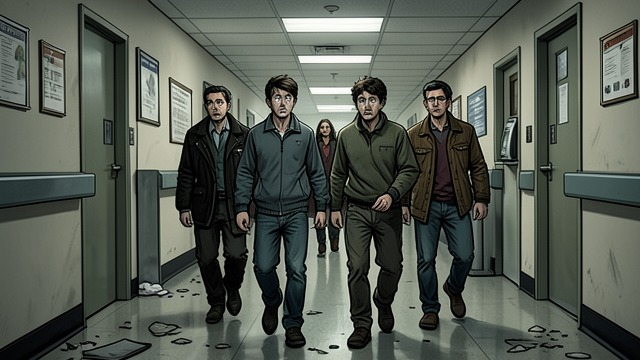
The friends’ response is not to celebrate the blow as a victory. They search for Gino, worry about his injuries, and hurry to the hospital after learning he has been found unconscious. The consequences expose how little control the boys have over the violence they try to manage.
No clean maxim
By the final scene, Lukas has neither embraced his father’s advice nor accepted the street’s demand to strike back. Retreat can leave victims trapped, but retaliation can make danger worse and put friends in greater peril.
The unresolved tension is central to the book’s moral world: these boys inherit rules built for survival, yet every rule can fail when fear, loyalty, and violence collide. The hospital journey leaves the question open rather than offering a confident adult answer.
After Lukas is beaten in the park
After the first park assault, as the friends return with Cem
Later that week, on the balcony with Marco
During the night walk with the stolen computers
Near the hospital visit at the novel’s end
